
Walk onto the forecourt of most Thai fuel stations today and there is a good chance the attendant at the screen is Lao or Myanmar — especially on night shifts, at border-area stations and in industrial zones. Yet the fuel station POS in front of them usually shows menus in Thai only. The result is pressing wrong buttons, selecting the wrong fuel grade, repeating voids and cash shortages nobody can explain. This article examines the issue most station owners overlook: the language on the dispenser-side screen, why it affects the cash drawer directly, and how a fuel station management program with full Lao and Myanmar menus closes this leak.
Why a Thai-only screen becomes a money leak
The workforce on Thai forecourts has changed a lot over the past decade. From hundreds of on-site installations, we see many stations where Lao and Myanmar staff form the backbone of high-traffic shifts. The problem is that most POS software in use was designed for Thai-only users, so these attendants work on screens they read slower than their own language — in a job measured in seconds, with queues of cars and fuel prices changing every few weeks.
The most frequent errors are everyday tasks: picking the wrong fuel grade because the buttons sit next to each other, keying the cash received too high or too low, voiding a sale and re-keying it without recording the reason, or changing the price on the wrong day. Each event looks small, but over a month it becomes the unexplained cash shortage that owners accept as normal operating loss — when its root cause is a screen that ignores its real users.
The hidden cost of input errors
Errors hit three layers. First, the cash shortage in that shift which someone must cover. Second, the hours spent investigating: managers reviewing reports, staff being questioned one by one. The third and most expensive layer is trust — when mistakes repeat, owners start suspecting everyone, the team becomes anxious, and good staff may quit because they feel audited like suspects. A one-button problem grows into a whole-team problem. See our real case on investigating cash shortages.
Comparing 3 screen approaches: Thai-only, English-only, or multi-language
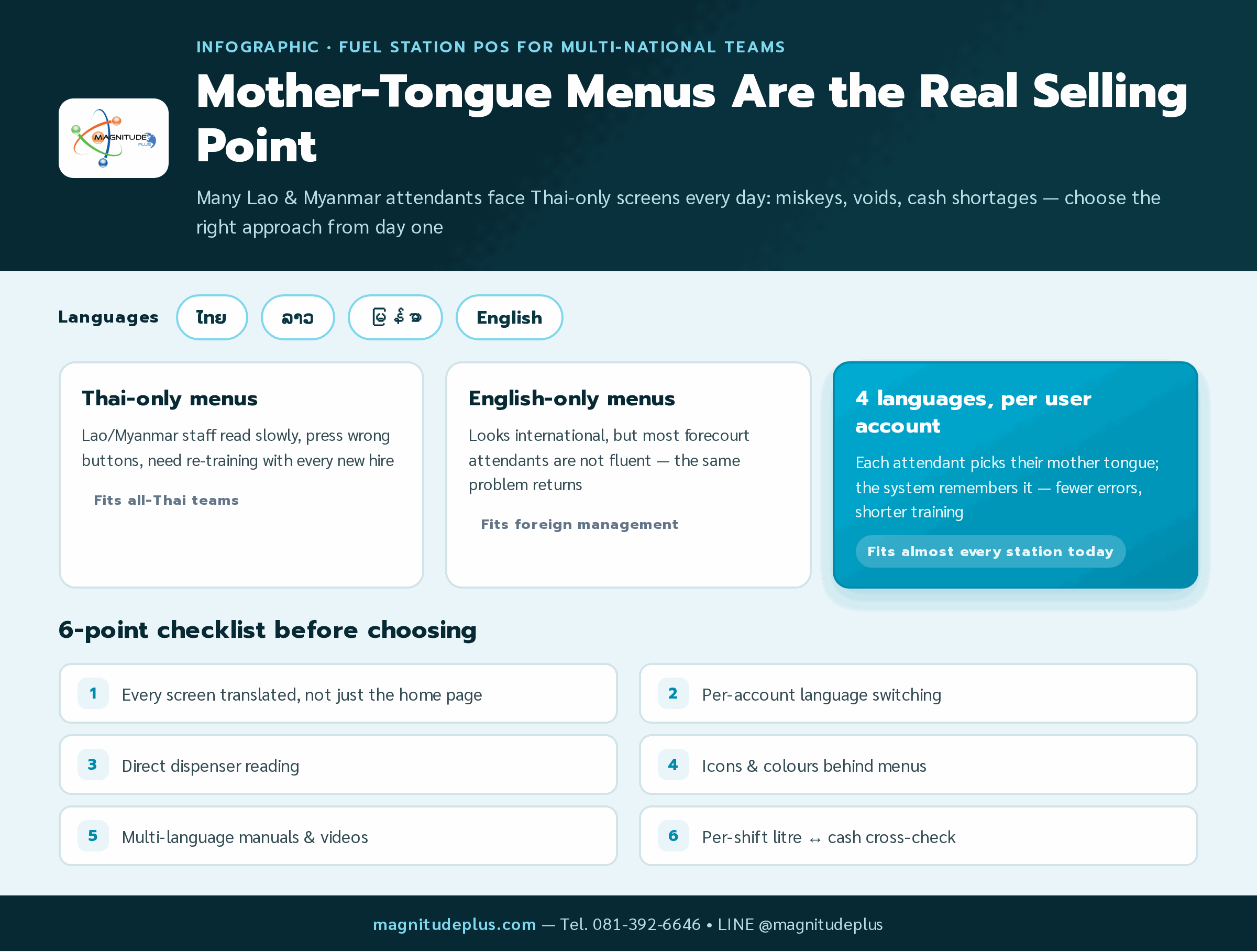
When choosing a system, owners have three options for the screen language. This table summarises strengths, real-world limits and which station each option fits — judged by forecourt practice, not by software screenshots.
| Screen approach | Strengths | Real-world limits | Best for |
|---|---|---|---|
| 1. Thai-only menus | Comfortable for Thai staff; software usually cheaper | Lao/Myanmar staff read slowly, press wrong buttons, need re-training with every new hire | Stations staffed entirely by Thai employees |
| 2. English-only menus | Looks international; suits foreign managers | Most forecourt attendants are not fluent — the same slow-reading problem returns | Multinational concession stations focused on management level |
| 3. Multi-language: Thai-Lao-Myanmar-English | Each attendant uses their mother tongue per account; fewer errors, shorter training | Requires a system where every screen is translated, not just the main menu | Almost every station today with a multi-national team |
The first two options each serve only one group, while the third matches the real workforce of Thai stations today. FuelSmart Station provides complete Thai, Lao, Myanmar and English menus on every screen. Each user sets their language at account level; after login the system shows their menu instantly. One terminal serves staff of many languages without anyone disturbing another's work.
The second dimension: stations in Laos and Myanmar can also order from Thailand
Multi-language menus are not only for stations inside Thailand. Fuel stations in Laos are growing fast and commonly order dispenser control systems from Thai developers, thanks to hardware standards, installation teams and short shipping distances. A system with a complete Lao menu — from the sales screen to management reports — lets stations in Laos operate without depending on Thai-speaking staff. Searches such as ໂປຣແກຣມປໍ້ານ້ຳມັນ still face very little competition, so developers who publish Lao-language guides hold a clear advantage.
Before deciding, neighbouring stations usually ask about after-sales support. A Thai system like the dispenser control program comes with engineers who cross the border for on-site installation and training, remote support over the internet, and manuals and tutorial videos in several languages — exactly what makes Lao and Myanmar attendants trust the system faster.
6-point checklist for choosing a POS for multi-national teams
- Every screen translated — not just the home page; ask for a live demo of voids, tax invoices and shift close in Lao or Myanmar
- Per-account language switching — the system remembers the setting; no re-configuration every shift
- Direct dispenser reading to minimise manual input — see the dispenser control program
- Icons and colours behind menus so staff who read slowly still act correctly with familiar patterns
- Manuals and videos in several languages so new hires self-train instead of burdening senior staff
- Per-shift litre-versus-cash cross-check reports so remaining errors are caught within the day, not at month end
In short, the screen language of the forecourt is not cosmetics — it is cost, paid every month as cash shortages, lost litres and training time. Stations whose system speaks every employee's language run faster teams, make fewer mistakes and audit totals in one system. For the wider selection criteria, read Compare 5 Fuel Programs 2026 and managing fuel station staff.
The MagnitudePlus team offers free consultation and a live demo of the 4-language system — sales screen and back office — for stations in Thailand and neighbouring countries. You can start from the FAQ or contact the team directly to schedule a real system demo.
Want a system that handles this for your station?
The MagnitudePlus team offers a free consultation, assesses your site and demos the system against the problems your station actually faces. No obligation — it takes just 15 minutes by phone.
FAQ about multi-language fuel station programs
Why do foreign fuel station cashiers make more input errors than Thai staff?
Because the screen is in Thai while their mother tongue is Lao or Myanmar. Reading menus slowly under forecourt time pressure leads to more wrong presses and wrong figures. Showing the menu in their own language fixes the root cause immediately.
Does a multi-language fuel station POS really reduce cash shortages?
Yes. The system reads litres directly from dispensers so most sales need no typing, and the parts that still do — shop items, voids — become accurate on the first attempt with mother-tongue menus. Shortages and back-checking time drop visibly.
Which languages are supported, and is switching difficult?
Thai, Lao, Myanmar and English. Each user account keeps its own language setting from login onward; one terminal serves a multi-language team with no re-configuration per shift.
Can fuel stations in Laos or Myanmar use a system from Thailand?
Yes — full Lao and Myanmar menus, cross-border installation and training by engineers, plus remote support. Many neighbouring stations order directly from Thai developers.
How fast can a new employee who has never used a computer learn the system?
With mother-tongue menus, icons and minimal steps, most attendants handle real sales on day one, so turnover no longer disrupts the station.