
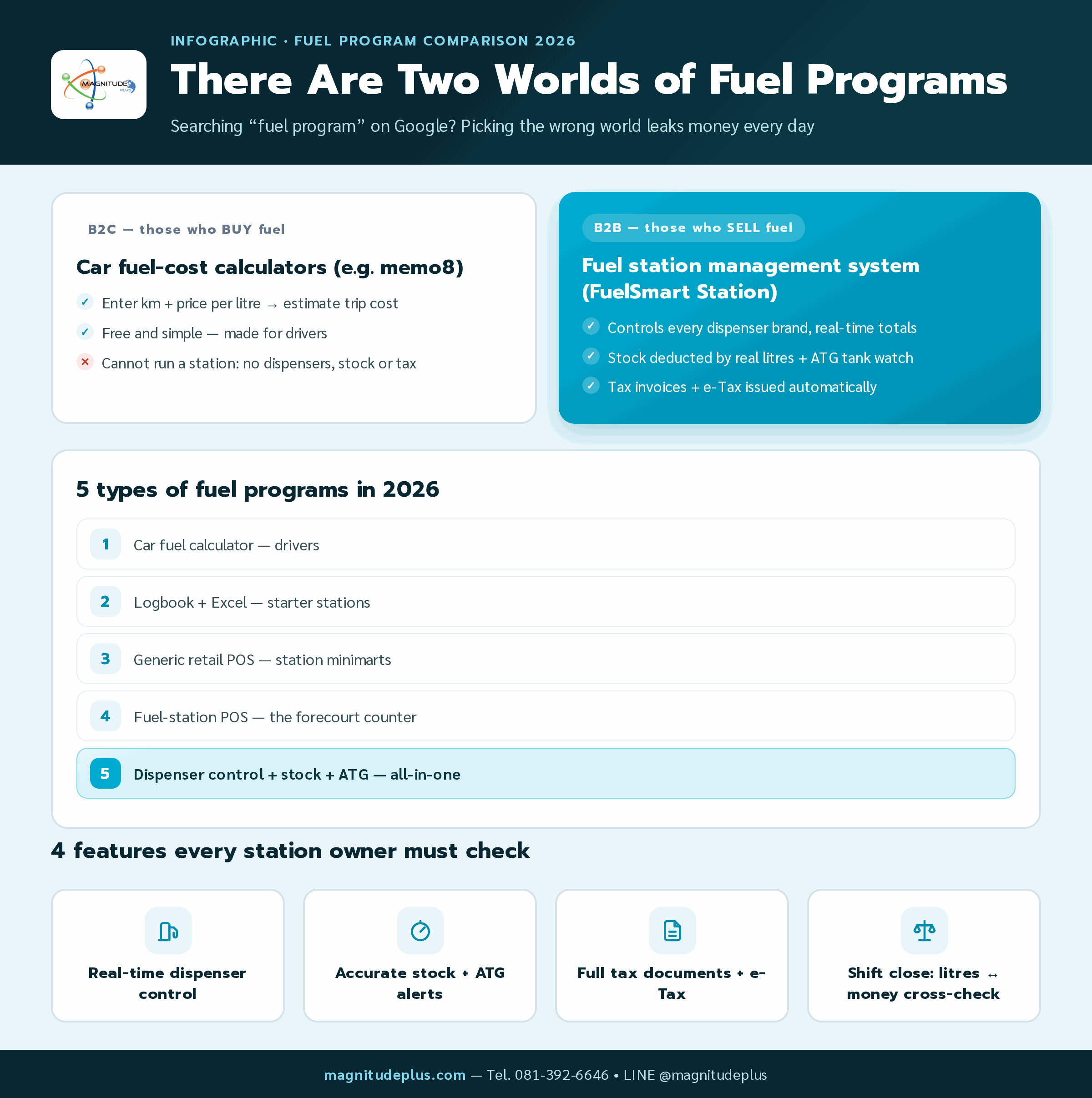
Try typing fuel program into Google. The first results are rarely station-management systems — they are generic car fuel-cost calculators like memo8 and tools where you enter kilometers to estimate a trip. Yet what a station owner like you is really looking for is a fuel station management system that controls dispensers, keeps stock under control and closes the day's money accurately. This article shows clearly that the same keyword covers two completely different worlds, then compares 5 popular fuel programs of 2026 so you can see which one fits your station — and which one actually stops the money leaks.
Why does searching “fuel program” only return car fuel-cost calculators?
The cause lies in Search Intent. The term fuel program is a neutral word used by two groups without any agreement between them. The first group is everyday drivers who want to know how much this trip will cost in fuel — a very large group that searches very often, so personal calculators hold the top rankings easily. The second group is station owners and managers looking for forecourt software — a smaller group but worth many times more per customer. The problem is that Google does not yet separate these two intents well, so station owners must filter the mixed results themselves.
Type 1: personal fuel-cost calculators (B2C)
These tools do one simple thing: take the distance, the consumption per kilometer and the price per liter, then estimate the travel cost. The best-known example in Thailand is memo8, which helps you record and calculate your own car's fuel costs, along with many similar websites and mobile apps. Their strengths are being free or cheap, easy to use and requiring no installation — perfect for drivers, delivery workers or anyone who wants to save on personal travel. But what they cannot do is run a station: they never connect to a dispenser, know nothing about tank stock, and have no business-grade tax document system.
Type 2: fuel station management software (B2B)
This category is designed for people who sell fuel, not those who buy it. It covers dispenser control software that authorizes dispensing and reads totals directly from the nozzles, a fuel station POS system for counter payments and documents, stock deducted by real liters, all the way to executive reports and tank gauging (ATG). An example developed by a Thai engineering team is FuelSmart Station by MagnitudePlus, used by both large standard stations and community pumps. This type of software is the true answer to the question of which fuel program fits a pump — something generic calculators cannot answer from the start.
Comparing the 5 most popular fuel programs of 2026
Gathering every option that Thai station owners actually use today, they fall into 5 main types. This table gives you the overview first — who each type suits and what its key limitation is — before we go deeper into the features station owners care about most in the next section.
| Fuel program type | Typical usage | Who it suits | Key limitation |
|---|---|---|---|
| 1. Car fuel-cost calculator (B2C) | Enter kilometers and fuel price to estimate a trip, e.g. memo8 | Private drivers, delivery drivers, small fleets saving on travel | No dispenser link, no stock, no tax documents — cannot run a station |
| 2. Logbook + calculator / Excel | Attendants jot totals per nozzle, summarized into a sheet at day's end | Starter stations that don't want to invest yet | High error rate, shortages noticed days late, monthly tax work is painful |
| 3. Generic retail POS | A shop checkout program brought to the station, prices keyed by hand | The convenience store inside the station, not the forecourt | Doesn't know dispensers, no stock by real liters, money and liters never reconciled |
| 4. Purpose-built fuel station POS | Counter payments, tax invoices, every payment channel supported | Stations that need fast forecourt service and correct documents | Used alone without dispenser control, totals still have to be keyed from the machines |
| 5. Dispenser control + stock + ATG, all-in-one | Controls every island, auto stock deduction, real-time tank watching, e.g. FuelSmart Station | Stations of any size that want leaks closed and totals visible anywhere | Investment differs from personal tools, repaid by fuel that no longer vanishes and time saved |
Notice that these five types do not compete head-on; they answer different intents. The first two serve personal use or the very first stage of a station, while the last three are the real business tier. So the owner's real question is not which program is better in general, but which feature group can actually stop money leaking in your pump — which is exactly what the next table answers, feature by feature.
Deep-dive comparison: the features station owners actually need
Once we zoom into the daily work of a real pump, the gap between generic calculators and commercial station systems becomes immediate. The following four things decide how fast a station can catch missing money — and how much the accountant suffers at every month-end.
| Feature station owners need | Manual / generic calculators | Commercial station management system |
|---|---|---|
| Link to and read totals straight from dispensers | Not possible | Real-time (prevents mis-recorded figures from attendants) |
| Controlled stock deduction for fuel in tanks | Not possible | Connects to ATG, detects fuel loss instantly |
| Full tax invoices / e-Tax | Not possible | Printed automatically at the counter, revenue-department standard |
| Shift close and cash-shortage checks | Keyed into a sheet by hand | Pairs liters with cash automatically — caught within the shift |
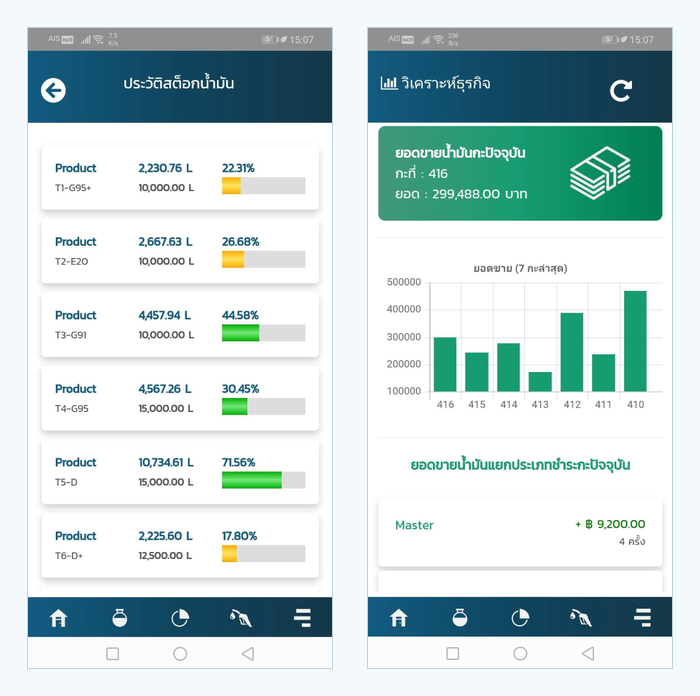
The most powerful row in that table is the last one, because it is where money disappears most often without anyone being clearly at fault: an attendant mistypes one digit, a customer pays cash at the counter but the liters go to another figure, or a sale is cancelled without a record. When the system automatically cross-checks liters against money every shift, the gap surfaces within the same day instead of at month-end when the trail is cold. A pump that quietly loses a few liters a day often loses, over a year, roughly the cost of the whole software — which is why we call a commercial system a fuel loss prevention tool that genuinely pays for itself.
The other row you should not overlook is tax documents. Stations still running on paper feel the pain every time a corporate customer asks for a backdated tax invoice or when the monthly sales-tax filing comes around. A commercial system prints receipts and tax invoices instantly at the counter and supports e-Tax Invoice and e-Tax Receipt to the revenue department's standard, so the station's accounting flows smoothly all month instead of collecting handwritten slips and re-keying them twice.
How to choose the fuel program that fits your business
No single system fits every station the same way. The heaviest factors are the station's size, the number of dispenser islands, the customer mix and the investment budget you can carry. The following recommendations are grouped by real business size so you can decide faster.
Large stations / multiple branches: connect three systems from day one
Large stations or branch networks should adopt the full suite that links the dispenser control system with the POS and the automatic tank gauging (ATG) from the very beginning, because high-volume stations multiply both human error and the gaps between systems that never speak the same language. The FuelSmart Station fuel program controls dispensers of every brand and deducts stock automatically; pair it with the tank gauging (ATG) system that watches fuel levels in real time. Multi-branch owners see every station's consolidated totals on one dashboard through the reporting and BI system instead of phoning branch by branch.
Community pumps / roadside pumps / coin-operated dispensers: accurate stock, totals on your phone
This group runs with few staff and a tight budget, yet loses money just as easily because handwritten logs are the norm. What it truly needs is a system that deducts stock accurately to prevent missing money and shows totals on a phone without visiting the site — the owner can be inspecting another pump or living in another province and still open today's sales and stock instantly. Systems designed for this group, like the community and roadside pump program, start at a far lower investment than large-station suites while keeping the same principle: every liter dispensed is recorded and deducted immediately, leaving no room for numbers to drift.
Summary: match the intent, close the leaks for real
The keyword fuel program hides two worlds in the same search results. The first world is the personal car fuel-cost calculator like memo8, which is excellent at its own job for drivers. The second world is the fuel station management system built specifically for station owners. If you sell fuel, the four features in the deep-dive table above are the criteria that instantly tell which program is ready to close your leaks and cut real costs. For further checklists, read choosing fuel station software: 7 must-have capabilities and dispenser control software: which brand connects properly? to cover every angle before deciding.
If you are ready to have an engineering team assess your site, the MagnitudePlus team offers a free consultation on dispenser control installation and a demo tailored to the problems your pump actually faces — no obligation, for large standard stations and community pumps of every size.
Want a system that handles this for your station?
The MagnitudePlus team offers a free consultation, assesses your site and demos the system against the problems your station actually faces. No obligation — it takes just 15 minutes by phone.
Frequently asked questions about fuel programs
What is the difference between a fuel program and a car fuel-cost calculator?
A car fuel-cost calculator (such as memo8) is a personal tool for estimating travel expenses by entering distance and fuel consumption — made for drivers. A fuel program for gas stations is station-management software that controls dispensers, deducts stock by actual liters, issues tax documents and closes shifts in one system — made directly for station owners.
Which type of fuel program should a community pump or small roadside pump use?
Choose a system that deducts stock accurately by the liters actually dispensed, alerts you when fuel runs low, and lets you view sales from your phone without visiting the site. Systems designed for community pumps cost less to adopt than large-station suites while preventing money loss from the very first shift. See the community and roadside pump program page for details.
Does a dispenser control system really prevent fuel loss?
Yes. The system reads liters straight from the dispensers in real time; every delivery is recorded automatically without handwritten logs, then liters are cross-checked against cash. If they do not match, you know within that shift instead of days later. You can also read the case study on cash shortages caused by staff.
Can a fuel program issue full tax invoices and e-Tax Invoice?
Commercial station systems print receipts and full tax invoices automatically at the counter, support e-Tax Invoice/e-Tax Receipt to the revenue department's standard, and consolidate corporate customers' end-of-month tax invoices automatically. Generic calculators cannot produce any business tax documents at all.
Can I keep my existing dispensers, or must I replace all station equipment?
In most cases there is no need to replace anything. Modern systems connect to nearly every dispenser brand through standard protocols such as Wayne, Tokheim, Gilbarco and Tatsuno, often reusing the existing signal cables. Have an engineering team survey the site before installation to confirm compatibility with the equipment your pump already has.